AI: Predictive models to anticipate the climate from 2050 to 2100
Major advances in AI are revolutionizing climate projection. ClimaX and FourCastNet offer faster and more accurate forecasts, surpassing traditional physical models. They enable better identification of at-risk areas and anticipation of tipping points.
WE
Rédaction Weather IA
samedi 23 mai 2026 à 09:53Updated mercredi 10 juin 2026 à 15:486 min
Imagine being able to visualize tomorrow's climate with unprecedented clarity, not in the next ten days, but over the next sixty years. This is the promise fulfilled by a new generation of climate models based on artificial intelligence. These tools, such as ClimaX and FourCastNet, are beginning to surpass traditional simulation methods, opening a window onto our planet's future evolutions with hitherto unparalleled speed and accuracy.
AI Models for Mapping the Climate Future
Scientists have long used complex and computationally intensive physical climate models to simulate the interactions between the atmosphere, oceans, and land surface. While these models have enabled considerable advances, their computation time can extend over weeks or even months for a single projection. The advent of machine learning and deep neural networks is changing the game. Platforms like ClimaX and FourCastNet, developed by leading research institutions, leverage vast atmospheric datasets, including satellite data and historical observations, to train predictive models capable of generating climate projections in a fraction of the time. Princeton University's Center for Climate Research, for example, has seen its work on similar AI models demonstrate the ability to produce global climate simulations with impressive spatial and temporal resolution, all in just a few minutes or hours.
The operation of these AI models relies on sophisticated machine learning principles. Instead of simulating fundamental physical laws step by step, as traditional models do, neural networks learn to recognize complex patterns and non-linear relationships within climate data. They are trained on decades of weather and climate observations, enabling them to reproduce atmospheric and oceanic dynamics. AI excels at detecting subtle correlations between different parameters (temperature, pressure, humidity, ocean currents) that might be missed by more linear, classical physical approaches. This ability to identify recurring patterns and complex interactions is essential for anticipating long-term evolutions. Neural network architectures like transformers, initially designed for natural language processing, are also adapted to analyze the temporal sequences of climate data, thereby improving the prediction of future trends.
Facing Physical Models: The Great Challenge
Direct comparison between AI models and established physical models, such as those developed by ECMWF (European Centre for Medium-Range Weather Forecasts) or the European Union's Copernicus program, is at the heart of current research. AI models, such as Google DeepMind's GraphCast or Huawei's Pangu-Weather, have already demonstrated their superiority for certain short- and medium-term weather forecasts, particularly in predicting extreme events like storms or cyclones. For long-term climate projections, the advantage lies in speed and the ability to explore a larger number of scenarios. AI allows for rapid testing of different greenhouse gas emission scenarios (similar to the old RCP - Representative Concentration Pathways scenarios) and evaluation of their potential impacts on global and regional climate. However, prediction uncertainty remains a major challenge. Physical models, grounded in the laws of physics, offer transparency and interpretability that may be lacking in AI models, often considered "black boxes." Cross-validation and continuous refinement are therefore crucial to ensure the reliability of AI projections.
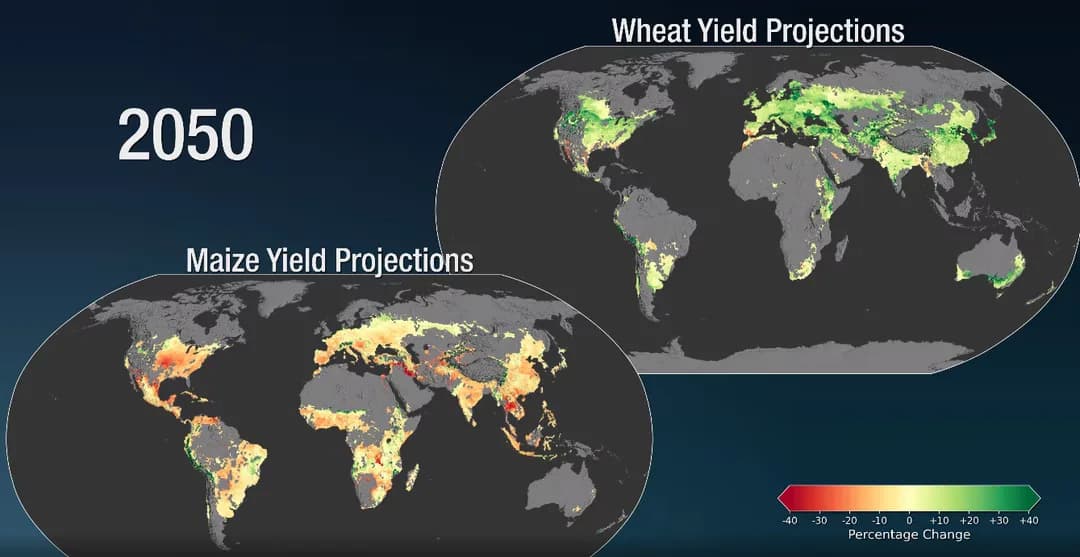
One of the most significant contributions of these new AI models lies in their ability to more accurately identify geographical areas that will be most affected by climate change. By simulating thousands of scenarios, these tools can map regions most vulnerable to sea-level rise, extreme heatwaves, prolonged droughts, or intense rainfall. This increased granularity is essential for adaptation planning and risk management. Furthermore, AI offers new potential for studying climate "tipping points" – those critical thresholds beyond which a climate system can change abruptly and potentially irreversibly. Phenomena such as the melting of the Greenland ice sheet, permafrost thaw, or the dieback of the Amazon rainforest are examples of tipping points whose precise anticipation is vital. AI models, by analyzing complex correlations and often underestimated feedback loops, could help us better understand the risks associated with these major transitions.
Towards More Predictable Weather and Climate?
The integration of these AI models into weather and climate forecasting systems does not mean replacing traditional approaches, but rather complementing them. The goal is to build hybrid systems, combining the computational power and speed of AI with the physical robustness of existing models. This could lead to more refined and reliable weather forecasts, but above all, to a better understanding of future climate trajectories. Policymakers, urban planners, farmers, and natural resource managers will thus have more powerful tools to anticipate the impacts of climate change and implement effective adaptation and mitigation strategies. The stakes are high: it is about better preparing our societies for the major environmental challenges of the coming decades, by leveraging computational power and artificial intelligence to inform our decisions.
As AI-based climate models continue to evolve, their potential to revolutionize our understanding and anticipation of climate change is immense. Current research aims to integrate more complex physical processes into these models, improve their interpretability, and deploy them on a global scale to provide ever more accurate and useful projections.