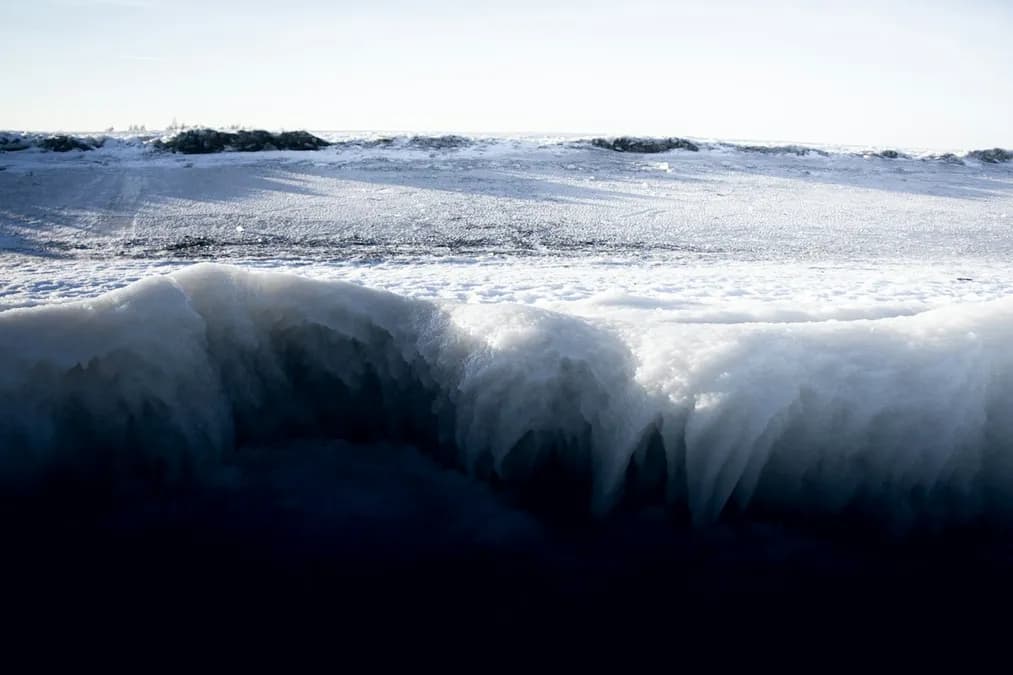
Melting of polar ocean ice: impacts on Arctic and Antarctic wildlife
Polar oceans are warming at an unprecedented rate, leading to accelerated melting of sea ice and the loss of essential habitats for wildlife. A new annual report details these transformations and their ecological consequences.
Transformation of polar oceans in the face of warming
Sea ice extents in the Arctic and Antarctica have dramatically retreated, reaching levels never observed since the start of satellite records. This massive reduction, confirmed by the latest annual report published Wednesday, signals a profound transformation of polar oceans, with rapidly increasing surface temperatures and marine habitats disappearing beneath warmer waters.
What the study reveals: precise results and key figures
The report, developed using Copernicus satellite data and ECMWF atmospheric models, shows that Arctic sea ice area has lost several million square kilometers over the past two decades, while Antarctic sea ice is experiencing continuous reduction, especially along coasts. Scientists emphasize that ice loss has a negative albedo effect, amplifying local warming. Moreover, observations indicate northward migration of many phytoplankton species, disrupting the food chain from its first link.
In terms of biodiversity, populations of walruses, emperor penguins, and ringed seals already show signs of stress: their breeding areas are contracting, and juvenile mortality rates are increasing. The report specifies that, according to weather models, forecast uncertainty remains high for extreme events, but the general trend of warming is clearly established.
How: research method and data used
To quantify these changes, teams combined deep neural networks with predictive models such as GraphCast and Pangu-Weather, integrating over 30 million satellite images and decades of atmospheric data. Machine learning enabled refinement of ice edge detection and estimation of temperature variations beneath the ocean surface with unprecedented spatial resolution. AI models were calibrated using in-situ observations, including Argo buoy measurements and polar research station records.
Researchers also exploited time series from the Sentinel-1 mission, coupled with ECMWF forecast model outputs, to reduce predictive uncertainty related to ocean convection phenomena. This hybrid approach, combining satellite data, neural networks, and physical models, provided a more coherent view of melting processes, ocean currents, and salt redistribution, key elements for understanding climate feedbacks.
Scientific explanation of the phenomenon
Warming of polar oceans is driven by increased heat uptake from the atmosphere due to reduced ice cover, leading to accelerated ice melt and changes in ocean circulation patterns. This, in turn, affects marine ecosystems and wildlife habitats, with potential cascading effects on global climate regulation.