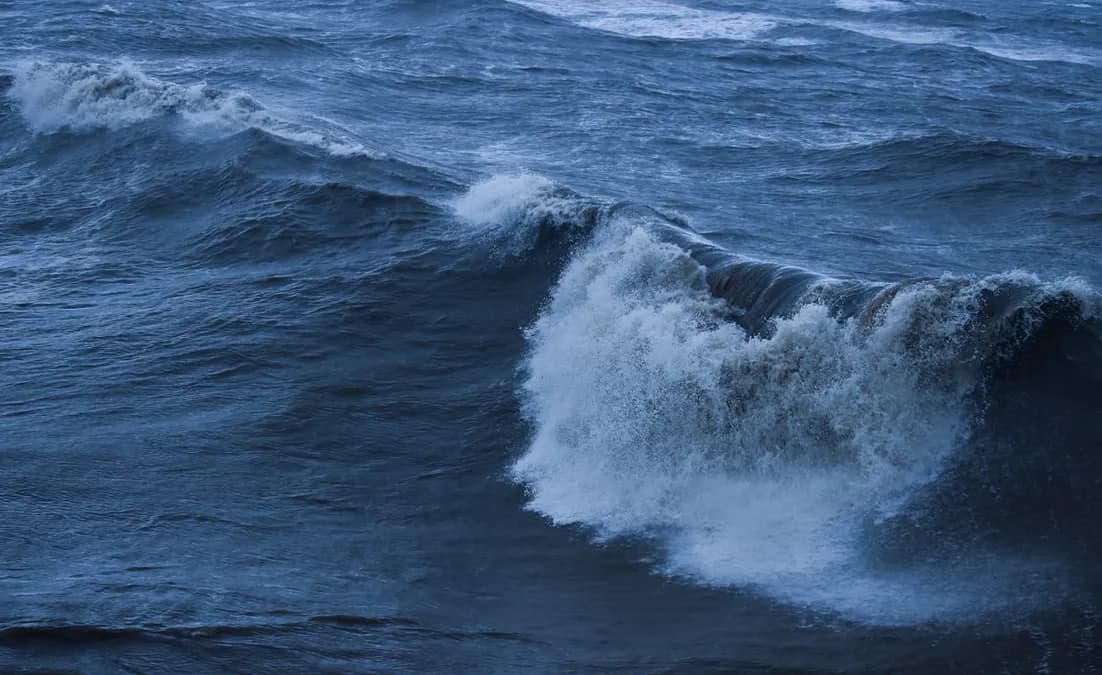
Buoys tracked ocean waves generated in the Australian Ocean, from storms in Antarctica to small ripples in Alaska. This study allowed us to understand how storms in the southern hemisphere influence waves across the globe. The results come from the analysis of data from 300 drifting buoys.
WE
Rédaction Weather IA
jeudi 4 juin 2026 à 20:07Updated mercredi 10 juin 2026 à 15:115 min
Ocean waves generated in the Australian Ocean have been tracked over a distance of 14,000 km, from storms in Antarctica to small ripples in Alaska. According to Professor Ian Young, of the University of Melbourne, this study has allowed us to better understand how storms in the southern hemisphere influence waves across the globe.
Ocean Waves: From Antarctica to Alaska
Data from 300 drifting buoys were analyzed for this study. The results show that ocean waves can travel considerable distances, influenced by winds and ocean currents. Storms in Antarctica play a key role in the formation of these waves, which can then propagate to other regions of the globe.
Storms in Antarctica are caused by atmospheric depressions that form above the Australian Ocean. These depressions create violent winds that, in turn, generate significant waves. The waves then propagate to other regions of the globe, influenced by ocean currents and winds. This study has allowed us to better understand this process and highlight the importance of storms in Antarctica in the formation of ocean waves.
Scientific Explanation of the Phenomenon
The phenomenon of ocean waves occurring in the Australian Ocean is due to the combination of several scientific factors. Firstly, storms in Antarctica are caused by atmospheric depressions that form above the Australian Ocean. These depressions create violent winds that, in turn, generate significant waves. The waves then propagate to other regions of the globe, influenced by ocean currents and winds.
Ocean currents play an important role in the propagation of waves. Warm and cold currents mix and create eddies that influence the direction and speed of waves. Winds, on the other hand, influence the height and frequency of waves. Storms in Antarctica are particularly important because they create waves that can propagate over long distances.
Regional Impacts
The regional impacts of ocean waves generated in the Australian Ocean are significant. Waves can cause substantial damage to coastlines and infrastructure, particularly in regions exposed to storms. Waves can also influence navigation and fishing, as they can make sea conditions hazardous.
The regions most exposed to ocean waves generated in the Australian Ocean are the coastlines of South America, Africa, and Asia. These regions are particularly vulnerable to storms and waves, as they are exposed to winds and ocean currents that influence wave propagation.
Practical Advice
It is essential to take precautions to protect oneself from ocean waves generated in the Australian Ocean. People living in regions exposed to storms and waves must be prepared to evacuate in case of a storm. It is also crucial to follow meteorological forecasts to be informed of sea conditions and storms that may occur.
Mariners and fishermen must also take precautions to protect themselves from ocean waves. They must follow meteorological forecasts and sea conditions to avoid areas where waves are particularly hazardous. It is also essential to have suitable safety equipment, such as life jackets and communication radios, to be able to request help if needed.
Comparison with Similar Past Meteorological Events
It is challenging to compare ocean waves generated in the Australian Ocean with similar past meteorological events, as meteorological conditions are unique each time. However, it is possible to say that storms in Antarctica are particularly important because they create waves that can propagate over long distances.
Storms in Antarctica are similar to those that occur in other regions of the globe, such as hurricanes and typhoons. However, storms in Antarctica are particularly powerful because they are influenced by winds and ocean currents present in the Australian Ocean.
Implications for Meteorological Forecasting
The results of this study have significant implications for meteorological forecasting. In fact, understanding how storms in Antarctica influence ocean waves can help improve storm and extreme meteorological condition forecasts in other regions of the globe. This can also help better understand the impacts of climate change on ocean waves and storms.
Meteorological forecasts are crucial for people living in regions exposed to storms and waves. Meteorological forecasts can help prevent damage and loss of human life by informing people of sea conditions and storms that may occur.
Conclusion
Ocean waves generated in the Australian Ocean are a complex phenomenon influenced by storms in Antarctica, ocean currents, and winds. The regional impacts of ocean waves are significant, as they can cause substantial damage to coastlines and infrastructure. It is essential to take precautions to protect oneself from ocean waves and to follow meteorological forecasts to be informed of sea conditions and storms that may occur.
The results of this study have significant implications for meteorological forecasting and for understanding the impacts of climate change on ocean waves and storms. It is essential to continue studying ocean waves generated in the Australian Ocean to better understand this complex phenomenon and to improve meteorological forecasts.