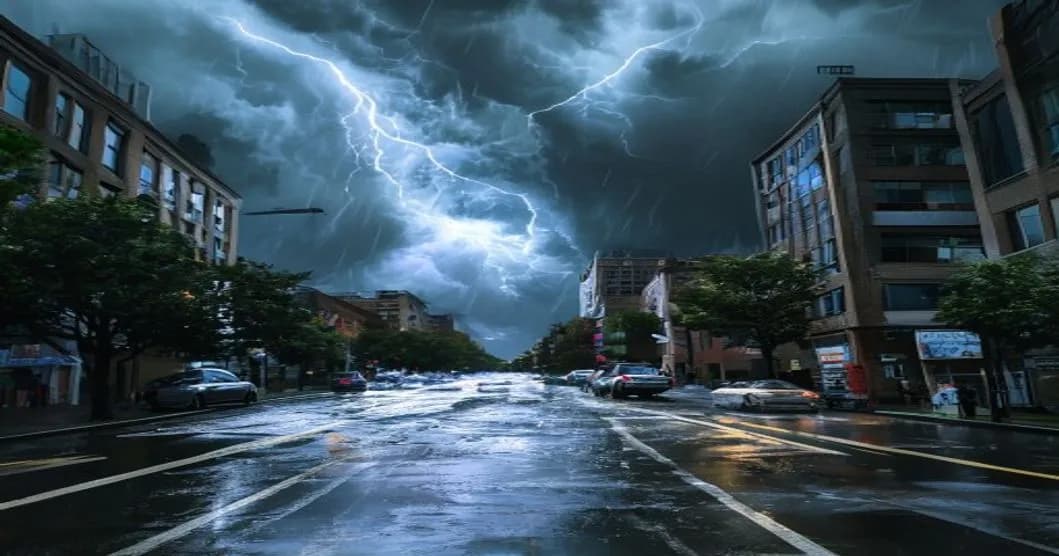
Urban Storms: Divergent Responses by Type, a Challenge for Weather AI
A new study published in Nature Climate reveals that cities react very differently to storms depending on whether they are convective, frontal, or tropical systems. This complex finding highlights the need to refine our predictive models, particularly those based on artificial intelligence, to better anticipate floods and their urban impacts. Understanding these nuances is crucial for the resilience of our metropolises.
WE
Rédaction Weather IA
mercredi 20 mai 2026 à 15:59Updated mercredi 10 juin 2026 à 16:366 min
Cities are not uniform amplifiers of storms; their responses to severe weather are surprisingly diverse, shaped by the very nature of the meteorological system passing through them. This striking conclusion comes from a recent study published in Nature Climate, which highlights an "urban response" that is divergent when faced with convective, frontal, or tropical systems. This new complexity represents a major challenge for modeling and predicting urban risks, where floods can cost billions and endanger lives.
Cities do not all react the same way to the same storms
Researchers found that the intrinsic characteristics of a storm—whether it is an intense localized convective downpour, an extended and persistent frontal system, or a powerful tropical cyclone—interact uniquely with the urban environment. A city will not experience the same consequences from a summer convective storm, characterized by heavy rains over a short period and a limited area, as it would from a frontal system bringing moderate but prolonged rainfall, or from a hurricane with its devastating winds and torrential rains over a wide swath.
This divergence is explained by how urban infrastructure, human-altered topography, and the urban heat island (UHI) effect influence the dynamics of each type of storm. For example, a convective downpour can be locally intensified by the UHI, leading to sudden flash floods. A frontal system, on the other hand, could gradually saturate soils and drainage networks, resulting in more widespread but less sudden flooding. Tropical systems often combine extreme rainfall and strong winds, exacerbating multiple vulnerabilities simultaneously.
How urban infrastructure transforms risk
Urban fabric is not a passive observer of meteorological phenomena; it actively modifies them. Impervious surfaces like concrete and asphalt prevent water infiltration, leading to rapid runoff and overloading of drainage systems. This phenomenon is particularly critical during intense and brief convective rains, where the volume of water that needs to be quickly managed is enormous. The researchers emphasize that this hydrological response speed is a key characteristic of urban vulnerability to storms.
The urban heat island effect, resulting from the absorption and storage of heat by building materials, can also influence the formation and intensity of thunderstorms. By creating temperature gradients and stimulating upward air movements, the UHI can, under certain conditions, favor the development or strengthening of storm cells above or downstream of cities. Additionally, the morphology of buildings can alter wind flows, creating zones of convergence or divergence that influence precipitation trajectories. These complex interactions are factors that predictive models must now integrate with unprecedented granularity.
Predicting the unpredictable: the AI model challenge
Understanding these divergent urban responses is crucial for improving the accuracy of weather and hydrological forecasts. Traditional numerical weather prediction models (NWP), while increasingly powerful at the synoptic scale, still struggle to capture these complex interactions at the local urban scale. That's where artificial intelligence and machine learning come into play, offering promising perspectives for refining our forecasting capabilities.
Systems like `GraphCast` from DeepMind's lab or `Pangu-Weather` from Huawei, based on vast `neural networks` and trained on decades of `atmospheric data` and `satellite data` (including that provided by `Copernicus`), have already demonstrated their ability to rival, if not surpass, classical physical models (such as those from the ECMWF) for medium-term forecasts. However, integrating urban specifics—surface roughness, energy flow alteration, water management—remains a major challenge. The goal is to develop `predictive models` that can not only anticipate a storm's trajectory and intensity but also precisely simulate how it will interact with the built environment and what the specific hydrological response will be to the type of storm. This would significantly reduce the forecast uncertainty for localized and extreme events.
What this means for urban planning and alerts
The conclusions of the Nature Climate study have direct implications for urban planning, infrastructure design, and early warning systems. Knowing that a city reacts differently to a convective storm compared to a frontal system means that risk mitigation strategies and emergency protocols must be adapted. For example, for convective systems, priority could be given to high-capacity drainage infrastructure and nature-based solutions (green roofs, floodable parks) to slow down surface runoff. For frontal systems, the focus could be on monitoring river and groundwater levels, as well as the resilience of critical infrastructure to prolonged flooding.
Early warning systems will also need to become more nuanced, no longer just signaling "heavy rain" but specifying the type of meteorological system expected and the specific risks associated for the urban environment. This would allow authorities and citizens to take more targeted and effective measures. Integrating these insights into the `next-generation predictive models`, powered by machine learning, would generate more precise impact scenarios, essential for real-time decision-making.
Toward more resilient cities against extremes
The research published in Nature Climate underscores the urgency of considering cities as dynamic entities that actively modify meteorological phenomena. In an era where climate change is intensifying the frequency and severity of extreme events, a fine understanding of these interactions is indispensable. Advances in AI and `predictive modeling` offer a promising path to turning these scientific discoveries into concrete operational tools.
By combining high-resolution observations, detailed urban data, and sophisticated machine learning algorithms, we can hope to develop systems capable of predicting not only the weather but also its specific impacts on each city, for each type of storm. This is a crucial step toward building more resilient cities, better prepared and able to adapt to future climate challenges. Collaboration between meteorologists, urban planners, and AI experts is more necessary than ever to realize this vision of hyper-local and intelligent urban forecasting.