Next-Generation Weather Satellites: How AI Is Revolutionizing Real-Time Local Forecasting
The Meteosat Third Generation satellites and CubeSat constellations produce massive volumes of atmospheric data. AI transforms these streams into precise and rapid local forecasts, a key advancement for modern meteorology.
WE
Rédaction Weather IA
vendredi 15 mai 2026 à 07:39Updated mercredi 10 juin 2026 à 17:445 min
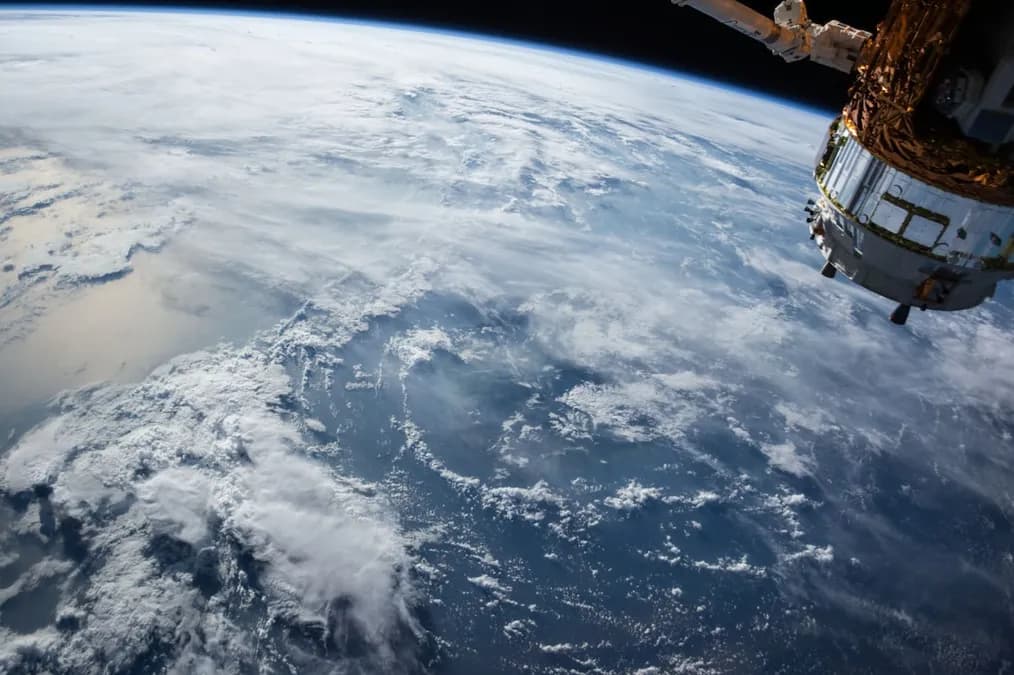
Every day, next-generation weather satellites capture tens of terabytes of continuous atmospheric data. These massive streams, notably from the Meteosat Third Generation satellites and CubeSat constellations, pose a major challenge: how to exploit this information in real time to improve the accuracy of local forecasts? Thanks to artificial intelligence, the answer is transforming meteorology.
Next-generation satellites producing a data avalanche
The Meteosat Third Generation (MTG) satellites, launched by the European Space Agency in collaboration with EUMETSAT, represent a leap forward in atmospheric observation. Their spatial and temporal resolution is far superior to previous generations, offering images and measurements approximately every 10 minutes, compared to 15 to 30 minutes before.
At the same time, CubeSat constellations, small compact satellites in low orbit, complement this data by providing specific complementary observations, notably on atmospheric composition and micro-weather events. Together, these platforms generate a colossal volume of satellite data, far too vast for manual processing or traditional methods.
Transforming raw data into local forecasts thanks to AI
The use of artificial intelligence, notably through deep neural networks, allows assimilation of these massive and heterogeneous data streams in real time. Machine learning models are trained to recognize complex atmospheric patterns and anticipate weather evolution at local scales.
This automated and ultra-fast processing of satellite data optimizes the detection of short-term weather phenomena, such as storms, fronts, or wind gusts. Beyond that, it refines the prediction of key variables (temperature, precipitation, wind) with improved spatial resolution, essential for precise weather alerts tailored to local needs.
A revolution for operational meteorology and public services
These advances play a crucial role for forecasting centers such as Météo France or the European ECMWF (European Centre for Medium-Range Weather Forecasts). By integrating outputs from AI models powered by MTG and CubeSat data, they can generate more reliable and detailed weather bulletins.
The ability to quickly anticipate violent phenomena improves natural risk management: early warnings for severe storms, flood management, and emergency intervention planning. For climate-sensitive economic sectors — agriculture, energy, transport — these ultra-precise local forecasts are a major asset.
Why this synergy between satellites and AI is crucial today
With climate change, the number and intensity of extreme weather events are increasing, making forecast precision and speed indispensable. The multiplication of satellite data demands tools capable of processing information on a global scale while ensuring fine response at the local level.
AI offers this real-time analysis capability, reducing forecast uncertainty and making alerts more relevant. Based on available data, this technology is becoming a standard in European and global meteorological centers, continuously improving the safety and resilience of populations facing climate hazards.
Technical challenges of MTG and CubeSat satellites in data collection
The Meteosat Third Generation satellites stand out for their sophisticated instrumentation, notably the infrared domain spectro-imager, which allows observation of atmospheric composition with increased precision. This capability enhances understanding of phenomena such as cloud movements or storm formation, providing more granular and exploitable data.
Meanwhile, CubeSats, thanks to their small size and lower operating costs, can be deployed in large numbers to cover specific geographic areas. Their low orbit gives them the advantage of collecting high-frequency data, essential for tracking rapid changes in the atmosphere. This technical complementarity between MTG and CubeSat maximizes the spatial and temporal coverage of meteorological observations.
Integrating satellite data into predictive models: a major computing challenge
Processing data from next-generation satellites requires powerful computing infrastructure and sophisticated algorithms. Artificial intelligence intervenes here to automate sorting, correction, and interpretation of data, often noisy or partial. This step is crucial to ensure forecast reliability.
Traditional predictive models are thus enriched by more numerous and diverse inputs, which complicates their calibration. However, deep learning techniques allow identification of correlations invisible to the human eye and improve simulation quality. This evolution marks a turning point in digital meteorology, where computing power is harnessed for fine understanding of atmospheric phenomena.
Future perspectives and innovations in space meteorology
As space technology advances, new generations of even more efficient satellites are envisioned, integrating multi-spectral sensors and enhanced autonomy capabilities. These advances will broaden the range of measured parameters, notably on air quality or humidity at different altitudes.
Moreover, the development of artificial intelligence is moving toward hybrid models combining physical and learned data, to anticipate complex scenarios related to climate change. This technological convergence paves the way for adaptive forecasting systems, capable of continuously adjusting to atmospheric evolutions and the specific needs of users.
In summary
The alliance between next-generation weather satellites, such as MTG and CubeSat constellations, and artificial intelligence is revolutionizing modern meteorology. By transforming massive volumes of data into precise local forecasts in real time, this synergy improves natural risk management and supports climate-sensitive economic sectors. Facing the challenges posed by climate change, these innovations are essential to strengthen societal resilience and ensure better meteorological safety worldwide.