Forecasting the Stratospheric Polar Vortex up to 7 Months in Advance Thanks to Climate
A new method developed by researchers at Florida State University allows predicting the behavior of the stratospheric polar vortex several months before winter. This breakthrough offers an unprecedented horizon to anticipate harsh winters and improve resource management.
WE
Rédaction Weather IA
jeudi 7 mai 2026 à 16:33Updated mercredi 10 juin 2026 à 18:396 min
Up to seven months in advance: this is the timeframe over which researchers at Florida State University can now anticipate the behavior of the stratospheric polar vortex (SPV), a key player in northern winters. This feat opens a new field for seasonal forecasting by allowing anticipation of intense cold episodes well before the start of the cold season.
A leap in forecasting the stratospheric polar vortex
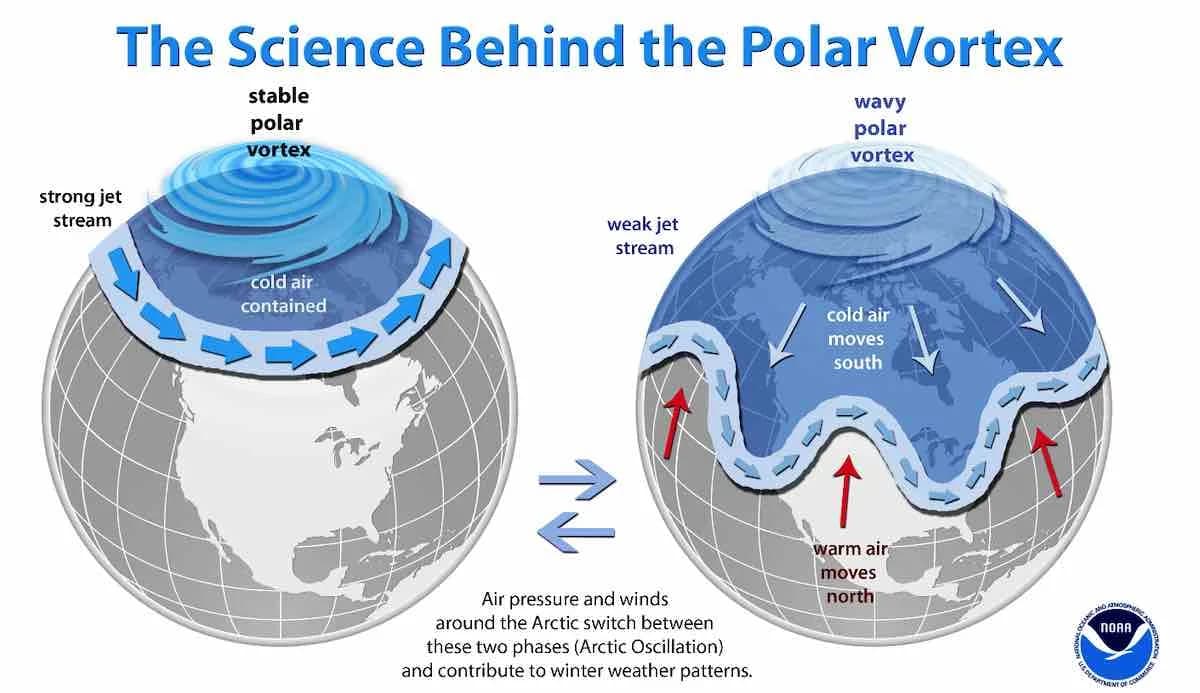
The stratospheric polar vortex, this gigantic mass of air rapidly rotating around the North Pole at high altitude, profoundly influences winter weather in Europe, North America, and Asia. Until now, its fluctuations were difficult to predict more than a few weeks in advance. But the method presented by the Florida State University team, published in the Journal of Geophysical Research: Atmospheres, changes the game by offering a reliable forecast of the SPV from winter up to the following summer, several months before winter even begins.
At the heart of this advance is an approach based on global climate indices and historical atmospheric data. Rather than focusing on immediate conditions, the researchers exploit the climate memory of the atmospheric system, notably temperature and wind anomalies in the stratosphere, to anticipate the dynamics of the SPV.
This method relies on long series of satellite data and reanalyses provided by organizations such as Copernicus and ECMWF. By combining machine learning and statistical models, it detects robust correlations between early climate signals and the future intensity or instability of the vortex.
Concrete impacts for agriculture, health, and energy
Anticipating the SPV several months in advance significantly improves preparation for harsh winters. Agriculture can adjust its sowing and crop protection strategies, while water management benefits from better forecasting of demand related to heating and irrigation.
In the energy sector, this lead time offers the possibility to optimize stocks and distribution, especially in regions dependent on electric or gas heating. Public health, finally, can better prepare for cold waves that increase cardio-respiratory risks, particularly among vulnerable populations.
With the worsening of climate change, winters are becoming more unpredictable. The ability to forecast the SPV several months in advance, revealed by this study, provides a valuable tool to reduce the uncertainties of current models. While extreme episodes remain rare but impactful, this method improves societies’ resilience to climatic hazards.
According to the original publication relayed by Phys.org, this technique paves the way for better integration of stratospheric forecasts into global seasonal models, a major challenge for modern meteorology and climatology.
A historical context of SPV forecasting
Understanding and forecasting the stratospheric polar vortex have long been limited by technological constraints and the complexity of atmospheric processes. Since the 1950s, researchers began to grasp the importance of the SPV on winter climates, notably through the study of sudden stratospheric warming (SSW) events that deeply disrupt the vortex. However, these phenomena remained unpredictable beyond a few weeks, limiting seasonal meteorological anticipation capabilities. The arrival of satellites in the 1970s, then increasingly sophisticated climate models, gradually improved forecasts, but no method until now could provide reliable anticipations several months ahead.
The tactical stakes of better vortex forecasting
The ability to predict the SPV behavior several months before winter profoundly changes adaptation strategies to winter climatic conditions. For resource managers, this means finer planning of energy stocks and heating infrastructures. Local communities can better prepare health and emergency services in case of prolonged cold waves. In agricultural sectors, anticipating winter severity impacts sowing choices, protection of sensitive crops, and soil management. Furthermore, insurance companies can refine their risk models, while economic actors, such as transport or distribution, can adjust their supply chains to limit disruptions related to bad weather.
Impact on the ranking of global climate models
The new method developed by Florida State University researchers represents a major advance for integrating stratospheric data into global seasonal climate models. By improving SPV forecasting, it reduces the margins of error that traditionally weigh on all winter predictions, notably regarding the frequency and intensity of cold waves at mid and high latitudes. This improvement could lead to recalibration of current models, strengthening their reliability and offering policymakers and economic decision-makers more precise tools to anticipate climate-related risks.
Prospects for evolution and future challenges
Despite these promising advances, several challenges remain to generalize the use of this method. The complexity of interactions between the stratosphere and troposphere still requires better scientific understanding, especially concerning the mechanisms governing the formation and dissipation of the SPV. Moreover, operational integration into meteorological forecasting centers demands significant computing resources and adaptation of existing models. Finally, communication around these long-term forecasts must be carefully calibrated to avoid misunderstandings or excessive confidence in forecasts that remain probabilistic. Nevertheless, the path traced by this study opens exciting prospects for better anticipation of extreme weather conditions on a seasonal scale.
In summary
Thanks to a new climatological method developed by Florida State University, it is now possible to forecast the behavior of the stratospheric polar vortex up to seven months in advance. This breakthrough revolutionizes seasonal forecasting, offering an unprecedented preparation horizon against harsh winters. Relying on historical data and sophisticated models, this technique improves management of key sectors such as agriculture, energy, and public health. As climate change makes winters more unpredictable, this innovation constitutes a valuable tool to strengthen societies’ resilience to weather hazards. While challenges remain for full operational integration, this discovery opens a new era in modern meteorology and climatology.