
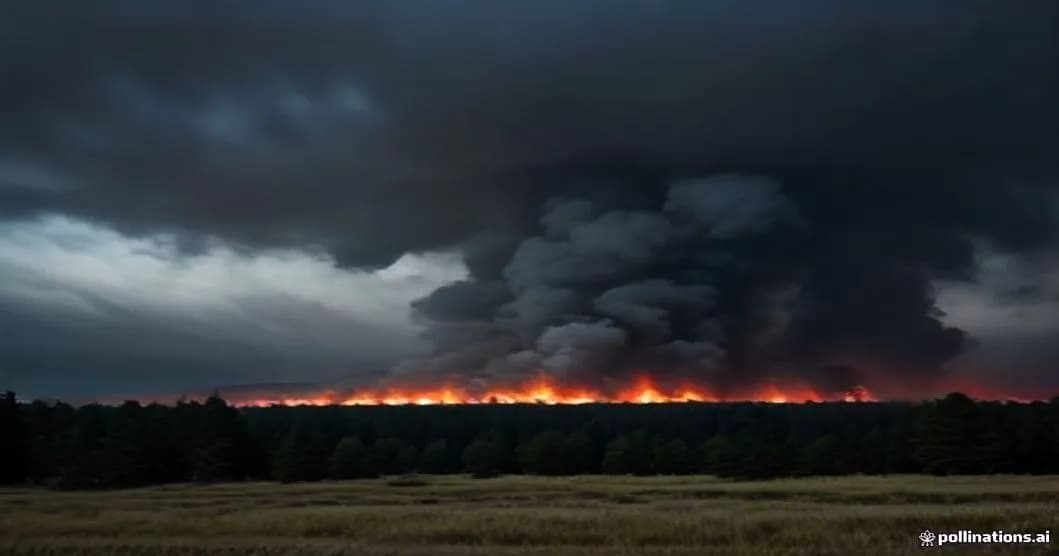
Early July 2026, Alex Honeyman and Mark Leone, post-doctoral researchers at Stanford University, attached a suitcase-sized box to a Colorado fire truck, ready to be deployed to a fire located 480 kilometers away. This mobile setup allowed for real-time capture of heavy metal concentrations such as lead, mercury, and arsenic in the smoke rising above the fire. Simply being able to measure these pollutants on-site opens the door to a new generation of health predictions during wildfire episodes.
What the study reveals: Real-time detection of toxic metals
The experience demonstrated that portable sensors integrated into a compact box can identify traces of heavy metals at concentrations well below usual alert thresholds. Measurements taken during the intervention showed varying levels of lead and mercury depending on proximity to the fire and wind direction, confirming that smoke composition is not homogeneous. Data collected also indicates that arsenic, although present in smaller amounts, appears sporadically, suggesting release linked to combustion of specific soil or vegetation materials.
These results are the first to provide a dynamic mapping of toxic metals right at the heart of a wildfire. Instead of relying solely on atmospheric dispersion models that integrate general hypotheses, researchers now have direct observations that can be compared with ECMWF forecasts or Copernicus products. This comparison allows for prediction uncertainty evaluation and adjustment of models based on in-situ measurements, reducing the gap between predictions and reality.