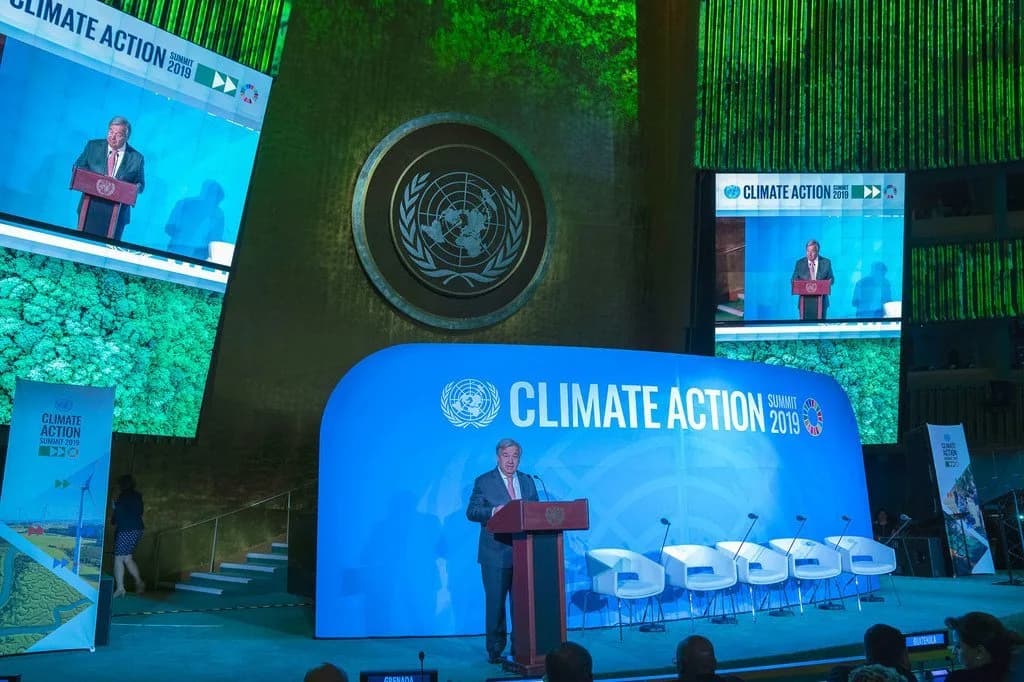
The United Nations is debating a resolution strengthening states' obligations in the fight against climate change. A long-awaited initiative, but one whose scope has been diluted under the influence of major greenhouse gas emitters.
WE
Rédaction Weather IA
samedi 23 mai 2026 à 09:54Updated mercredi 10 juin 2026 à 22:187 min
Discussions are intensifying within the United Nations. The General Assembly is currently examining a resolution aimed at consolidating countries' commitments in the fight against climate disruption. However, this proposal, called for by many nations and environmental organizations, has seen its content watered down in the face of pressure from the world's largest polluters, raising questions about its real effectiveness.
The promise of strengthened, but diluted, action
At the heart of the debates is a draft resolution that reaffirms and, theoretically, strengthens the obligations of member states in combating climate change. The idea would be to create a more binding framework to accelerate the ecological transition and achieve the goals set by the Paris Agreement. However, the negotiations have been the scene of intense bargaining. Countries whose economies rely heavily on fossil fuels have worked to soften the text, fearing repercussions on their industries and competitiveness. The result is a less ambitious version, which, according to some observers, risks not being enough to reverse the alarming trend of global warming.
The stakes of this resolution are high: it must serve as a 'lifebuoy' for a climate in crisis, as highlighted by many representatives from island nations and countries most vulnerable to the impacts of climate change. These nations have been advocating for years for more decisive international action, including financing mechanisms for adaptation and compensation for losses and damages incurred. The current version of the resolution, while reaffirming the importance of climate action, seems to have sacrificed some of its ambition on the altar of diplomatic consensus. The mention of 'strengthened obligations' is thus surrounded by caveats and references to existing frameworks, rather than establishing clear and measurable new constraints for major emitters.
AI to inform climate decisions?
While political negotiations are moving at a snail's pace, science and technology offer increasingly powerful tools for assessing risks and modeling future scenarios. Artificial intelligence, in particular, plays a growing role in understanding the climate. Sophisticated predictive models, trained on enormous volumes of atmospheric and satellite data, now allow for more accurate simulation of the impacts of warming. Initiatives such as those led by ECMWF (European Centre for Medium-Range Weather Forecasts) with models like GraphCast, or research on Pangu-Weather, demonstrate the ability of machine learning to anticipate complex weather phenomena much further in advance than traditional physical models. These advances, based on neural networks capable of identifying subtle patterns in data, could provide decision-makers with crucial information to assess the urgency and scale of the measures to be taken. Forecasting uncertainty, while still present, is gradually reduced thanks to these tools, offering a clearer picture of the potential consequences of current emissions.
Scientific reports, such as those from the IPCC, constantly remind us: time is running out. Global greenhouse gas emissions must be reduced drastically and rapidly to limit warming to 1.5°C above pre-industrial levels, a critical threshold beyond which the consequences would become potentially catastrophic and irreversible. Extreme weather events, increasingly frequent and intense – heatwaves, floods, droughts, hurricanes – are already a lived reality for millions of people worldwide. A UN resolution, even weakened, has the merit of opening a space for dialogue and reaffirming collective commitment. However, the effectiveness of this 'lifebuoy' will depend on the real willingness of states to move beyond short-term national interests to adopt ambitious and binding policies, supported by solid scientific data and, potentially, by the contribution of artificial intelligence technologies in analyzing and forecasting climate impacts.
The weight of the past: a history of climate negotiations
The United Nations has been the scene of climate negotiations for several decades. The history of these discussions is marked by partial successes and disappointments, reflecting the complexity of economic, political, and social issues. Foundational agreements like the Kyoto Protocol attempted to establish binding frameworks, but their scope was often limited by exemptions or non-ratification by major players. The Paris Agreement, while praised for its universal approach, relies heavily on voluntary national commitments (Nationally Determined Contributions - NDCs), whose ambition struggles to align with the 1.5°C target. The current resolution falls within this lineage, seeking to strengthen the existing framework, but faces the same challenges: reconciling urgent environmental imperatives with economic realities and the geopolitical interests of states.
The voices of the most vulnerable: a call for climate justice
Beyond the major economic powers, the nations most exposed to the consequences of climate change, such as the island states of the Pacific or many regions of Africa and Asia, have a particularly audible voice in these forums. They constantly remind us that current warming is the result of historical emissions far greater from developed countries. Their advocacy is not limited to emission reductions but also includes strong demands for climate finance, adaptation, and, above all, 'loss and damage' mechanisms to compensate for damages already incurred and unavoidable. The dilution of the UN resolution is perceived by many as a lack of solidarity and a jeopardizing of climate justice, exacerbating inequalities in the face of a crisis for which these countries are least responsible.
AI as a tool for acceleration and transparency
While diplomacy struggles to find ambitious common ground, artificial intelligence offers new prospects for accelerating the ecological transition and strengthening transparency. The AI models mentioned previously, by improving the accuracy of weather and climate forecasts, can help better anticipate extreme events, optimize the management of renewable energy resources, and assess the effectiveness of mitigation and adaptation policies. Furthermore, AI can be used to analyze vast datasets on emissions, deforestation, or water consumption, thus allowing for finer verification of commitments made by states and companies. The integration of these technologies into the monitoring and evaluation of climate policies could thus become a powerful lever for ensuring more effective implementation of international agreements, despite political compromises.
Towards concrete action?
The international community now awaits to see how this resolution will be translated into action on the ground. The coming years will be decisive in assessing whether the commitments made, even in their watered-down form, will succeed in bending the emissions curve and protecting the most vulnerable populations. The integration of technological advancements, including those from AI, into adaptation and mitigation strategies could prove to be an essential lever for strengthening the effectiveness of climate policies in the face of the urgency.