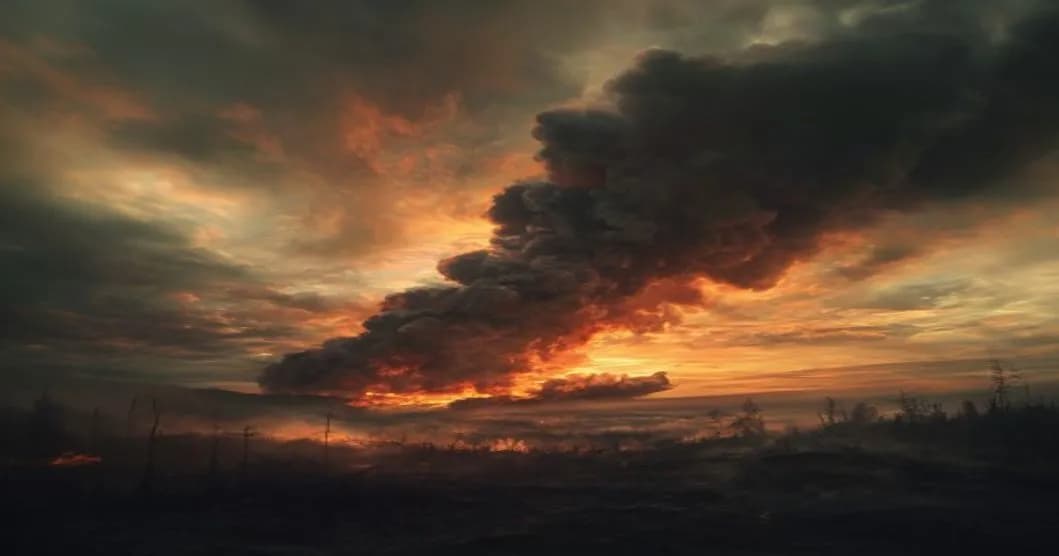
Forest fires emit much more than CO2. A study reveals that brown carbon, from the incomplete combustion of vegetation, traps heat significantly, amplifying the greenhouse effect. This complex phenomenon could rewrite certain climate models.
WE
Rédaction Weather IA
mercredi 20 mai 2026 à 19:23Updated mercredi 10 juin 2026 à 16:007 min
Forest fires, already recognized for their devastating impact on ecosystems and human health, play a more insidious and complex role in climate warming than previously thought. A study published in Nature Climate Change highlights the importance of brown carbon, a component of smoke from the incomplete combustion of biomass, which acts as a powerful heat trap. While carbon dioxide (CO2) remains the primary greenhouse gas, this brown carbon could alter our understanding of Earth's radiative balance.
What the Researchers Found: An Underestimated Radiative Impact
Scientists analyzed brown carbon emissions from various types of fires worldwide, using satellite data and ground measurements. Their conclusions are unequivocal: brown carbon, often underestimated in current carbon budgets, has a significant radiative effect. It absorbs a portion of solar radiation, warming the atmosphere, and can also influence cloud formation and the reflection of sunlight back into space. The study estimates that the direct warming effect of this brown carbon, once its indirect impacts are accounted for, is greater than that of CO2 emitted by fires over certain periods and regions.
How It Works: The Complex Chemistry of Brown Carbon
Brown carbon, or soot, is not a single molecule but a complex mixture of partially burned carbon particles. Unlike black carbon (pure soot), brown carbon contains organic compounds that give it even more pronounced solar light absorption properties, especially when it is still fresh and moist in the atmosphere. When dispersed in the air, it forms aerosols that can interact with solar radiation in several ways. It directly absorbs solar energy, warming the atmospheric layer where it is located. Furthermore, it can alter cloud properties by acting as condensation nuclei, thus affecting their ability to reflect sunlight. This dual action, direct absorption and cloud modification, contributes to a net warming of the planet.
What This Means for Climate Modeling
The precise integration of brown carbon's effect into climate predictive models is now crucial. Current models, while sophisticated, have often treated aerosols in a simplified manner. The study suggests that the magnitude of warming caused by brown carbon may necessitate significant adjustments in future projections. This could explain some observed discrepancies between model predictions and climate reality. The ability of these particles to influence cloud cover, a key element in regulating Earth's energy balance, makes their study particularly complex but essential for refining our climate forecasts.
With the increasing frequency and intensity of forest fires, exacerbated by climate change itself, the role of brown carbon becomes a major concern. Fires in the Arctic, Australia, California, and the Amazon release enormous quantities of these particles. Understanding and accurately quantifying this impact is essential for developing effective mitigation strategies. It could also influence forest and fire management policies, placing greater emphasis on fire prevention and control, not only for their immediate impacts but also for their indirect but powerful contribution to global warming. Advances in satellite observation and machine learning could play a key role in monitoring and modeling these complex emissions.
The research underscores the interconnectedness of Earth systems: a local phenomenon like a wildfire has global repercussions on the climate. Raising awareness of these less obvious effects is a necessary step towards more robust climate science and more targeted actions in the face of the climate emergency.
Impact on Global Carbon Budgets: A Missing Piece of the Puzzle
Traditionally, the focus of scientists and policymakers has been on long-lived greenhouse gas emissions like CO2 and methane. However, this new study highlights the need for a reassessment of the contributions of aerosols, particularly brown carbon, to the greenhouse effect. Brown carbon particles have a shorter atmospheric lifespan than CO2, but their solar radiation absorption power is considerably higher during their time in the atmosphere. This means their warming impact can be more immediate and intense, albeit transient. Integrating these effects into global climate models is fundamental to refining future temperature projections and understanding the speed at which warming is occurring.
Brown Carbon and Ice Melt: A Vicious Cycle
The impact of brown carbon is not limited to the atmosphere. When these particles fall on icy surfaces, such as ice sheets, glaciers, or snow, they reduce albedo, which is their ability to reflect sunlight. A darker surface absorbs more heat, thus accelerating ice melt. This phenomenon, particularly concerning in polar and mountainous regions, creates a vicious cycle: fires contribute to warming, which leads to ice melt, which in turn exposes more dark surfaces capable of absorbing heat, amplifying warming. This complex interaction between fire emissions, atmospheric climate, and icy surfaces is a new and worrying facet of the climate crisis.
Towards Better Risk Management and Adapted Climate Policies
Recognizing the predominant role of brown carbon in climate warming has direct implications for how we approach fire risk management and climate policy development. It is imperative to strengthen fire prevention strategies, not only to protect populations and habitats but also to limit the emissions of these powerful warming agents. This could involve increased forest surveillance, more effective clearing programs, and better management of agricultural practices that can lead to fires. Furthermore, international climate agreements may need to incorporate specific measures to account for these aerosol emissions, recognizing their significant and often underestimated contribution to the planet's overall thermal balance.
In Summary
In conclusion, this research published in Nature Climate Change reveals that wildfire smoke, through the brown carbon it contains, exerts a significant warming effect, potentially greater than the CO2 emitted by the same fires over certain temporal and spatial scales. This discovery underscores the urgency of integrating these particles into climate models, understanding their complex interactions with clouds and icy surfaces, and adapting our fire prevention strategies and climate policies to account for this crucial but often overlooked component of climate change.