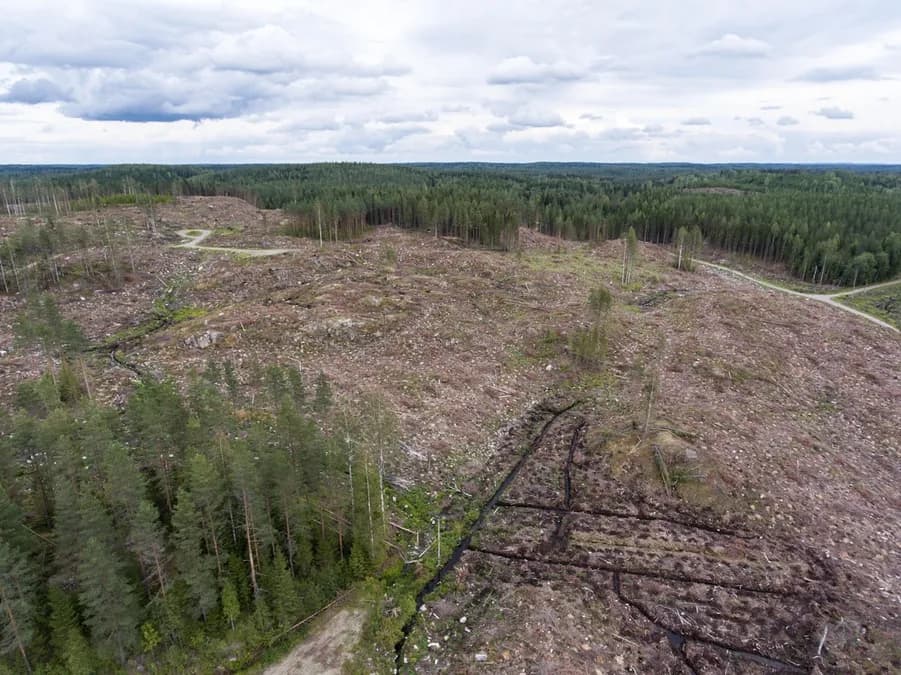
Deforestation in the Amazon: Warming Accelerates the Decline in Rainfall from 2026
A new study reveals that climate change accelerates the critical threshold at which deforestation causes a lasting collapse of rainfall in the Amazon. Warming and drying of the region make the forest more vulnerable to rainfall loss.
WE
Rédaction Weather IA
vendredi 8 mai 2026 à 05:12Updated mercredi 10 juin 2026 à 20:466 min
Each year, increasing deforestation in the Amazon significantly reduces precipitation, but climate change now worsens this effect. A recent study highlights that warming accelerates the Amazon forest's sensitivity to moisture loss, lowering the deforestation threshold at which rainfall drastically drops.
A sharp drop in rainfall linked to a lowered deforestation threshold
Researchers observed that even without climate change, massive tree cutting in southern Amazonia causes a severe and lasting decrease in precipitation. However, this new work shows that global warming alters atmospheric dynamics in the region, making rainfall more vulnerable as soon as deforestation reaches a lower level. In other words, the "tipping point" toward a marked reduction in rainfall occurs earlier than before.
How deforestation and climate interact to alter the water cycle
The Amazon forest plays a key role in the hydrological cycle by recycling water through evapotranspiration, a process where trees release water vapor into the atmosphere. Deforestation reduces this evapotranspiration, leading to less cloud formation and therefore less rain. At the same time, regional warming intensifies air drying and increases soil evaporation, further disrupting the moisture cycle. This double constraint creates a negative feedback effect, where the forest loses its ability to maintain a humid climate.
Consequences for Amazonian weather and climate in 2026
With increasing drying, predictive models indicate that the region risks experiencing longer and more intense drought periods. This decline in rainfall threatens local biodiversity and agriculture, while also reducing the forest's role as a carbon sink. According to the authors, this situation raises serious questions for the sustainable management of the Amazon basin and the preservation of its vital climatic functions.
A crucial warning in an already tense climatic context
As 2026 falls within a decade marked by a global temperature rise, this study emphasizes that climate change does not just increase temperatures: it also modifies ecosystems' vulnerability to human pressures. In the Amazon, this phenomenon accelerates the risk of rapid and almost irreversible degradation of the water cycle, with global impacts on the climate.
This research, reported by Phys.org Earth Science, calls for integrating these interactions into climate models and environmental policies to better anticipate risks and act effectively on deforestation and greenhouse gas emissions.
For several decades, the Amazon has been at the heart of global environmental concerns due to rapid and massive deforestation. Historically, this region has faced increasing pressure linked to agricultural expansion, logging, and urbanization. These human activities have already transformed a significant portion of the primary forest, compromising its ecological role. Previous studies showed that the Amazon forest acts as a major climate regulator, but this new research reveals that the forest's capacity to maintain its own hydrological cycle is now threatened at an accelerated pace.
This dramatic situation occurs in a context where forest protection policies struggle to keep pace with degradation. Local and international governments face complex challenges mixing economic development and environmental conservation. A deep understanding of the interactions between climate change and deforestation is therefore crucial to guide future political decisions and preserve the integrity of the Amazon.
Tactical issues for sustainable forest management
Given these findings, sustainable management strategies must integrate the climatic dimension to be effective. Traditional approaches based solely on limiting deforestation are no longer sufficient, as climate change modifies the critical thresholds beyond which impacts become irreversible. The strategy to adopt must therefore include climate change adaptation measures, such as ecological restoration, creation of forest corridors, and improving ecosystem resilience.
Moreover, regional cooperation among Amazonian countries is fundamental to coordinate efforts and avoid displacement of deforestation to less protected areas. Environmental policies must also be accompanied by economic incentives for local populations to reconcile development and conservation. Finally, international awareness of the Amazon basin's importance for the global climate must be strengthened to mobilize more resources and commitments.
Climatic perspectives and global impact
The consequences of accelerated deforestation combined with climate change go far beyond the Amazon's borders. Indeed, the forest plays a major role in regulating temperatures and precipitation not only in South America but also globally. A significant reduction in rainfall in this region can lead to changes in distant climatic regimes, notably affecting agricultural zones in South America and beyond.
Furthermore, the decrease in forest cover reduces the capacity to absorb carbon dioxide, thus contributing to amplifying the greenhouse effect. This vicious circle complicates global efforts to limit global warming. In this sense, the study urges considering the Amazon as a key element of global climate policies, where forest protection is inseparable from the fight against climate change.
In summary
Deforestation in the Amazon, combined with climate change, accelerates the decrease in precipitation by lowering the critical threshold at which rainfall sharply drops. This phenomenon compromises the forest's vital hydrological cycle, heralding more severe droughts, biodiversity loss, and a diminished capacity of the forest to absorb carbon. In a historical context marked by increasing human pressure, this study highlights the urgency of adopting integrated strategies combining deforestation reduction, climate adaptation, and international cooperation. The stakes transcend the Amazon region and call for a global mobilization to preserve this green lung essential to the global climate.