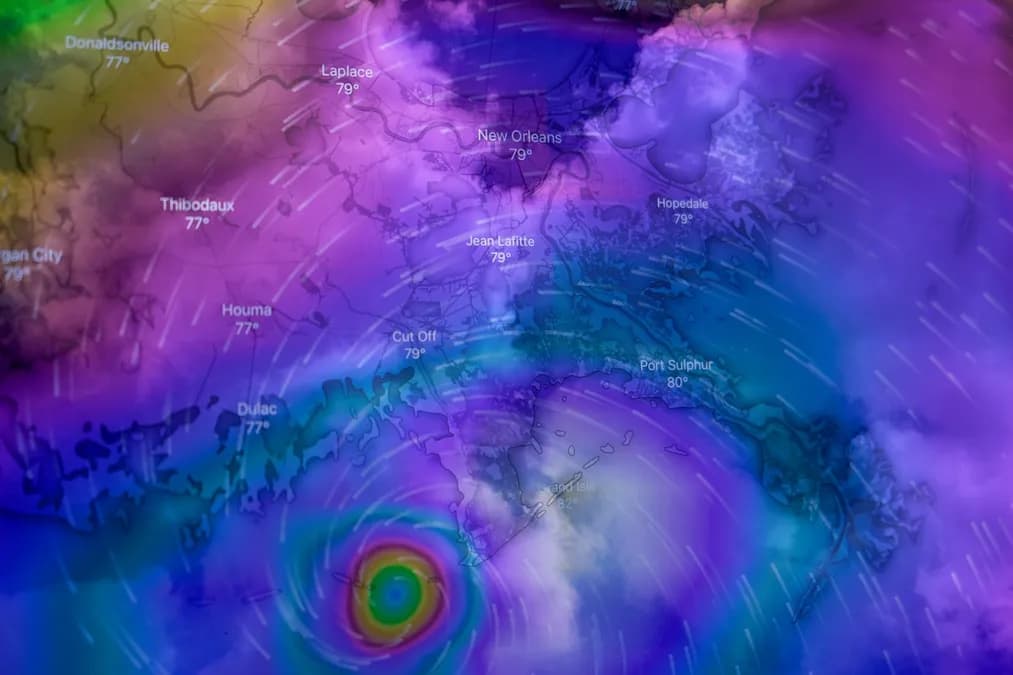
Tropical Cyclones: How AI Refines Hurricane Trajectory and Intensity
Deep neural networks improve tropical cyclone forecasting with an increased accuracy of 15 to 20%. Models like SHIPS-NN and HAFS are revolutionizing evacuation alerts by refining trajectories and intensities.
WE
Rédaction Weather IA
samedi 16 mai 2026 à 04:58Updated mercredi 10 juin 2026 à 21:406 min
15 to 20% improvement: this is the accuracy gain brought by deep learning neural networks in forecasting the trajectories and intensities of tropical cyclones, according to available data. This advance marks a significant step in hurricane monitoring, where every kilometer of anticipated trajectory can save lives.
AI models like SHIPS-NN and HAFS push the limits of prediction
Traditional cyclone forecasting techniques rely on complex physical models, but their margin of error remains a major obstacle for authorities. Machine learning models, notably SHIPS-NN (Statistical Hurricane Intensity Prediction Scheme - Neural Network) and HAFS (Hurricane Analysis and Forecast System), exploit deep neural networks to analyze vast volumes of atmospheric data. These models integrate various parameters derived from satellite data, in situ measurements, and outputs from global models such as ECMWF.
How neural networks improve detection of trajectories and intensities
Deep learning, through artificial neural networks, captures complex patterns in atmospheric data that classical models struggle to model. By continuously processing high-resolution satellite data as well as key atmospheric variables (temperature, pressure, wind), these networks refine the understanding of the dynamic and thermodynamic mechanisms governing cyclone trajectory and intensification. They thus reduce forecast uncertainty by better anticipating rapid intensity changes and trajectory deviations.
Their impact on evacuation alerts and risk management
Improving cyclone forecast accuracy by 15 to 20% has a direct impact on crisis management. Evacuation alerts can be issued earlier and with more confidence, limiting human and material losses. For example, the HAFS model, by combining real-time atmospheric data with AI algorithms, provides meteorologists with a powerful tool to anticipate hurricane evolution up to several days in advance. This allows optimizing evacuation strategies and natural disaster preparedness.
Why these advances are crucial in the face of increasing climate risks
With climate change, tropical cyclones are becoming more intense and unpredictable. Rising ocean temperatures fuel their energy, making extreme events more frequent. In this context, AI models represent an innovative response to overcome the limits of traditional physical models. Their ability to integrate variable data masses and quickly adapt to new atmospheric conditions is a major asset for the meteorological community and vulnerable populations.
According to available data, the growing use of these AI models in meteorological centers is part of a global trend to strengthen resilience against major climate hazards. Improving the accuracy of cyclone forecasts is an essential lever to reduce the human and economic impact of hurricanes, especially in exposed areas.
A historical context of cyclone forecasting in full evolution
Forecasting tropical cyclones has always been a major challenge for meteorology. Since the first attempts in the early 20th century, prediction models have undergone constant evolution, moving from empirical methods to sophisticated numerical physical systems. Yet, despite these advances, the chaotic nature of atmospheric phenomena limits forecast accuracy, particularly regarding trajectory and intensity. The introduction of artificial intelligence in this field represents a major breakthrough, offering a new analytical dimension capable of handling the complexity and non-linearity inherent in cyclones.
Historically, forecast errors could reach several hundred kilometers, complicating the implementation of effective preventive actions. With the integration of deep neural networks, meteorologists can now better understand subtle interactions between atmospheric variables, significantly reducing error margins. This technological evolution is the result of decades of research and computing power improvements, as well as the growing availability of detailed data provided by satellites and modern measurement systems.
Tactical stakes for meteorological centers and authorities
The accuracy gains offered by AI models like SHIPS-NN and HAFS are not only technical; they also have strategic repercussions for risk management. For meteorological centers, this means being able to deliver more reliable and earlier forecasts, which is crucial for planning emergency interventions. Local and national authorities can thus refine their evacuation plans, adapt allocated resources, and anticipate logistical needs.
These improvements also allow better communication with the public, reducing confusion and panic often associated with cyclone alerts. Moreover, by decreasing false alarms or erroneous forecasts, these models help maintain public trust in civil security systems. The tactical stakes are therefore twofold: optimize operational response and strengthen social resilience to natural disasters.
Future prospects for artificial intelligence in cyclone meteorology
The growing development and integration of artificial intelligence in cyclone forecasting open promising perspectives. As deep learning algorithms become more sophisticated, they will be able to integrate even more diverse data sources, such as real-time ocean observations, drone data, or socio-economic information related to exposed populations. This holistic approach could improve not only the accuracy of trajectories and intensities but also the assessment of potential impacts.
Furthermore, international collaboration is essential to share data, models, and best practices to optimize forecast efficiency worldwide. AI advances also offer the possibility to automate certain analysis tasks, freeing experts to focus on interpreting results and making strategic decisions. Finally, AI integration in cyclone meteorology fits into a broader dynamic of climate change adaptation, where speed and accuracy of information are key factors to save lives and protect infrastructure.
In summary
The 15 to 20% improvement in the accuracy of tropical cyclone trajectory and intensity forecasts thanks to deep learning neural networks constitutes a major advance for modern meteorology. The SHIPS-NN and HAFS models illustrate the effectiveness of artificial intelligence to analyze and interpret complex atmospheric data, thus providing authorities with indispensable tools to anticipate extreme phenomena. Facing a changing climate context, these technological innovations play a crucial role in risk management and population protection, while opening the way to new perspectives for cyclone forecasting and overall resilience.