How the Morning Fog Envelops the Victorian Alps in the Southern Hemisphere Autumn
Every autumn in the southern hemisphere, the valleys of the Victorian Alps are covered by a thick morning fog, a spectacular phenomenon captured by NASA's Terra satellite. This cloud veil plays a key role in the local microclimate and offers valuable study grounds for atmospheric science researchers.
WE
Rédaction Weather IA
mercredi 13 mai 2026 à 04:49Updated mercredi 10 juin 2026 à 21:055 min
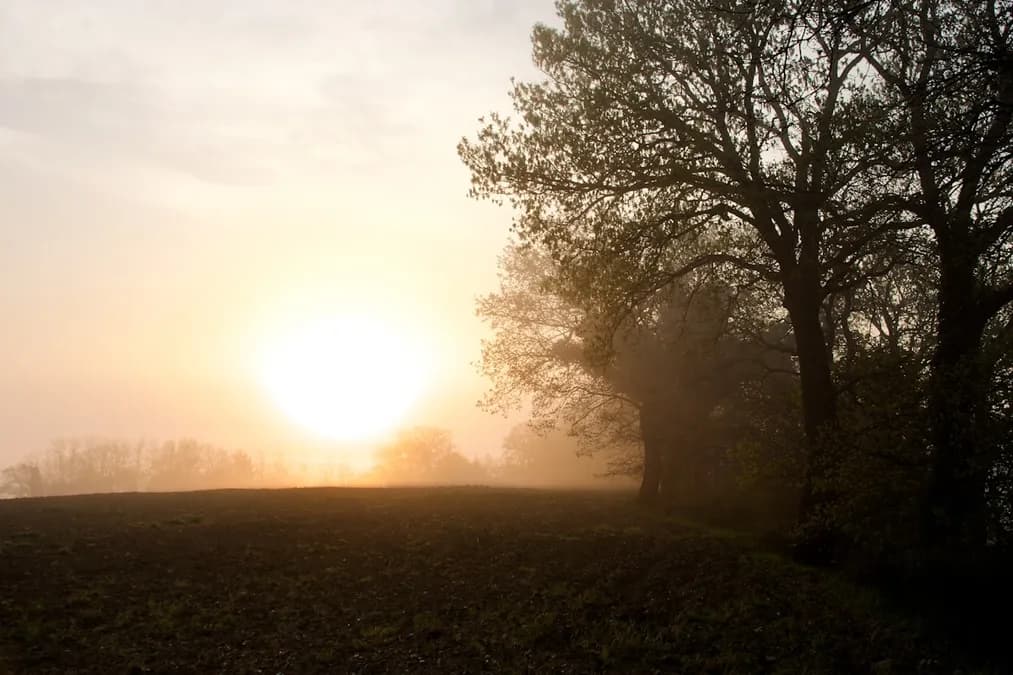
Every autumn morning, a striking natural spectacle unfolds in the Victorian Alps, Australia: a thick fog rushes into the valleys, covering the national parks with a white and mysterious cloak. This image, captured in May by NASA's Terra satellite, perfectly illustrates this transitional season in the southern hemisphere, where atmospheric conditions favor the formation of dense fog.
Morning fog in the Victorian Alps: a well-identified seasonal phenomenon
The Victorian Alps, with their steep relief and numerous national parks, are particularly conducive to fog formation during autumn. When nighttime temperatures drop, the air close to the ground cools rapidly, causing the condensation of water vapor contained in the atmosphere. This morning fog then fills the valleys, as shown by the satellite view taken by Terra, offering a striking contrast with the still clear summits.
The formation of fog in these mountainous regions is mainly due to intense radiative cooling during the night, combined with high relative humidity. The relief acts as a natural trap for cold air, which descends into the valleys. This phenomenon, called thermal inversion, creates a microclimate where cold and humid air remains trapped near the ground. The fog is thus a visible manifestation of these physical processes linked to topography and local atmospheric dynamics.
Implications for local meteorology and climate
Beyond its aesthetic aspect, the morning fog in the Victorian Alps influences several local climatic parameters, such as daytime temperature, soil evapotranspiration, and biodiversity. For meteorologists, understanding its formation and dissipation is crucial to refine local forecasts, especially in a context where predictive models must integrate the complex interactions between relief, humidity, and temperature. Satellite data, like those provided by Terra, are essential to monitor these phenomena and improve the accuracy of forecasting models.
Why this phenomenon deserves particular attention today
With climate change, the thermal and water balances of mountainous regions are evolving, which could modify the frequency and intensity of seasonal fogs. These changes impact not only local meteorology but also the fragile ecosystems of the Victorian Alps. Monitoring and understanding variations in this morning fog thus becomes a priority to anticipate the effects of warming on these sensitive environments, while optimizing atmospheric modeling tools in the medium and long term.
According to NASA, these satellite observations feed the Copernicus and ECMWF databases, thereby strengthening the capabilities for analysis and forecasting of local phenomena related to topography and climate. They also illustrate the power of space data in the fine understanding of regional atmospheric processes.
The role of national parks in preserving alpine ecosystems
The national parks of the Victorian Alps, which extend over several thousand hectares, play an essential role in conserving the natural environments where this morning fog forms. These protected areas shelter a rich and varied biodiversity, notably endemic species adapted to the particular climatic conditions of the region. The fog, by maintaining a high humidity level, notably contributes to the survival of certain plants and microorganisms that depend on this moisture for their life cycle. Thus, the local dynamics of the fog are intimately linked to the overall health of alpine ecosystems.
Satellite technologies and environmental monitoring: an indispensable duo
The view provided by NASA's Terra satellite is just one example among many of how space technologies are revolutionizing environmental monitoring. Thanks to multispectral sensors, these satellites can not only visualize fog layers but also analyze their composition and evolution over time. This information is crucial for researchers studying interactions between climate, topography, and vegetation. Furthermore, the collected data help better understand extreme meteorological phenomena, such as frost or drought episodes, which can durably affect the Victorian mountains.
Research perspectives and challenges for the future
As global climate models become increasingly sophisticated, integrating precise observations of local phenomena like the morning fog of the Victorian Alps remains a challenge. Scientists plan to improve the spatial and temporal resolution of satellites to track these events at the valley scale, even at the microclimate level. Moreover, collaboration between space agencies, research institutes, and local authorities is essential to develop adaptation strategies in the face of climate change. These efforts will ultimately allow better protection of natural resources while ensuring the safety of populations and infrastructures located in these sensitive areas.
In summary
The spectacle of morning fog in the Victorian Alps is much more than a simple natural curiosity: it reflects a complex interaction between climate, topography, and ecosystems. Captured by NASA's Terra satellite, this seasonal phenomenon highlights the importance of space technologies in monitoring and understanding local atmospheric processes. Facing the challenges posed by climate change, continuing the study and monitoring of this fog proves essential to preserve alpine biodiversity and refine weather forecasts. Thus, this cloud veil, which envelops the southern valleys every morning, remains a valuable indicator of the fragile balance between nature and climate in this emblematic region of Australia.