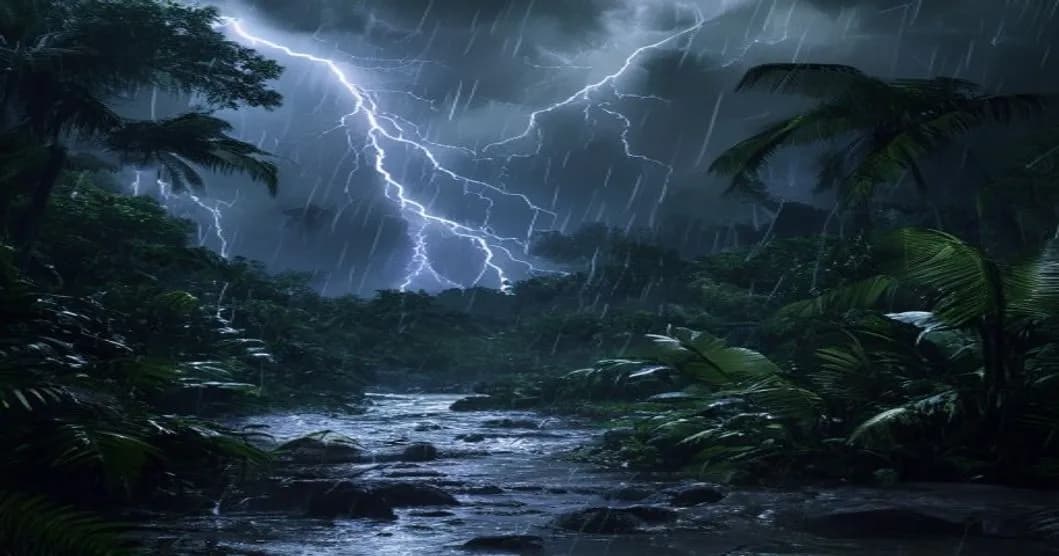
Latin America: The climate's "hydrological whip" intensifies
Between prolonged droughts and devastating floods, Latin America is experiencing increasingly extreme weather. A new report warns of the "hydrological whip," a climatic instability with disastrous consequences for the region.
WE
Rédaction Weather IA
mercredi 20 mai 2026 à 18:36Updated mercredi 10 juin 2026 à 16:295 min
The year 2025 is shaping up to be a dramatic turning point for Latin America and the Caribbean, facing unprecedented climatic instability. Massive floods are no longer able to erase the scars of long-term droughts, temperatures continue to climb beyond bearable limits, and once-rare weather phenomena are now part of the region's new climatic reality. A report by the World Meteorological Organization (WMO) highlights this alarming trend, illustrated by the multiple extreme events that have struck Mexico alone.
The "Hydrological Whip": A Region Caught Between Two Extremes
The concept of the "hydrological whip" describes a brutal oscillation between periods of extreme drought and episodes of devastating floods. This instability is particularly pronounced in Latin America, where hydrological cycles are disrupted by global warming. The WMO report, cited by Inside Climate News, highlights how the region has gone from historic drought to torrential rains within a few months, or even weeks in some areas. This volatility makes water resource planning and management extremely complex for governments and local populations.
Scientists are observing an increase in the frequency and intensity of extreme weather events in the region. Droughts, such as those that have hit Chile, Argentina, and Brazil, lead to widespread water shortages, affecting agriculture, hydroelectric power production, and urban water supply. At the same time, torrential rains cause flash floods, landslides, and considerable damage, as has been the case in Peru and Colombia. This dichotomy makes it difficult to apply classic predictive models, which struggle to anticipate these rapid and extreme changes. Artificial intelligence, through predictive models based on machine learning and the analysis of vast atmospheric datasets, is beginning to offer new perspectives for better understanding these complex phenomena by analyzing subtle patterns that physical models struggle to capture.
The Unavoidable Role of Climate Change
Experts agree that anthropogenic climate change is the main driver of this intensification of extreme phenomena. The increase in global temperatures, fueled by greenhouse gas emissions, is altering atmospheric circulation and precipitation patterns. Warmer oceans provide more moisture to the atmosphere, favoring more intense rainfall, while drought periods are exacerbated by increased evaporation. The WMO report emphasizes that warming is particularly pronounced in Latin America, a region that is nevertheless less responsible for historical CO2 emissions. Satellite data and climate simulations, often processed by sophisticated neural networks, confirm this trend and help to better attribute these events to global warming.
The consequences of this "hydrological whip" are manifold and directly affect Latin American populations. Agricultural losses lead to growing food insecurity and rising prices. Infrastructure is damaged, requiring considerable investment in reconstruction. Population displacement due to natural disasters is increasing, creating new social and economic challenges. The report specifically mentions the case of Mexico, which has experienced a diversity of extreme climate events, illustrating the region's vulnerability. Artificial intelligence models, such as those developed by institutions like ECMWF (European Centre for Medium-Range Weather Forecasts) or inspired by advances like those from Copernicus, are increasingly being used to try to anticipate these risks and help implement more effective adaptation strategies.
The WMO report calls for global awareness and strengthened commitments to combat climate change. Latin America, already on the front lines of the devastating effects of warming, can no longer afford to wait. The coming years will be decisive in assessing the region's ability to navigate these troubled waters, between endless droughts and sudden deluges, a reality exacerbated by the "hydrological whip."